


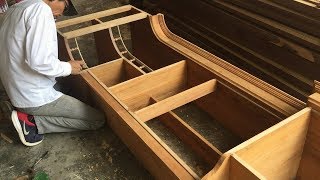
Taxing Issues for Woodworking Business

Realistically, most of us know woodworking amateurs who market a piece or 2 annually without reporting the income that is excess. But that does not make it.
You are subject to taxation legislation, if you market any of your job. By ignoring those legislation, you are put should state tax officers or the Internal Revenue Service learn about it.
Authentic, IRS representatives have tamed . State auditors especially tax auditors, are keen on ferreting from the market in crafts and more varied. And should somebody is caught by the state, that individual may turn into the IRS.
Honesty is the best coverage in your part irrespective of who is doing the assessing. Trouble is, honesty isn't made by taxation legislation . Rules ventures like woodworking--that straddle the line between business and hobby--may appear confusing.
Getting your woodworking handled as a company for tax purposes has two benefits. One, you are permitted to deduct costs for workshop and equipment area. And two, you are also able to deduct any losses from the day job from your company from income.
The IRS is cautious, but of woodworkers who attempt to classify themselves. You are not composing your equipment's price and if you clearing a gain, this should not be a issue. But you are writing off equipment outlays or if you've experienced a reduction, you can face evaluation, such as an audit of your income-tax documents.
The tax people classify your woodworking for a firm if:
You've made a gain from it in three to five decades.
You run in a businesslike manner (for example, by maintaining complete financial documents).
Woodworking is your source of revenue.
All three criteria are, however met by woodworking companies. Nevertheless, amateurs still should report income from earnings, less the costs. However, you can not deduct costs for conducting your workshop. And it is not likely you will have the ability to deduct costs for gear. If you do, you can deduct only the portion which exceeds 2 percent of your normal earnings, and you will want to keep thorough records so that you subtract only for the proportion of time that you used the equipment for company (rather than hobby usage).
A hobby woodworker is not bad tax-wise. Consider this: You won't need to pay when income exceeds $ 400 self-employment taxation, which amounts to approximately 13 percentage. As an instance, let's say you are in the 28% tax bracket in the day job, sell $2,000 worth of furniture that you built (after deducting material costs) and may deduct $500 of gear expenses under company tax rules. You would pay $ 560 in income taxes on that if taxed as a hobbyist. If taxed as a business you would pay $ 615 in self-employment taxes and income. Tax forms for companies are complex which means that you are going to pay more.
Whether your woodworking acts for taxation purposes as a company or a hobby, here are
Keep receipts and records of expenses and income related to your activity.
By phoning 1-800-TAXFORM if you believe that your woodworking qualifies as a company, get kind 1040-ES, and follow the directions to pay quarterly taxes so that you penalized or aren't surprised come.
Know more click on this link http://www.band-saw.com/start-woodworking-business/
Contact your state's department of revenue for principles regulating local and state revenue taxes.
Get help from representative that is enrolled, accountant, or a tax preparer.
Comments